Sharpen at the angle your knife already has. That is the answer, and the reason it is the answer is that the pages telling you 15, or 17, or 20 are each describing a different knife and none of them can see yours. You can find your own bevel with a permanent marker in about a minute, and once you have found it the argument stops being interesting.
Angles in this article are stated per side, which is the convention every maker below uses. A knife described as 15 degrees is 15 per side and 30 degrees included. Half the confusion on this subject is two people quoting the same edge with a factor of two between them.
Four ranking pages, four different answers
These four were read in full on 17 August 2026, not summarized from search results. Set side by side, they do not converge.
| Page | What it recommends |
|---|---|
| Sharpening Supplies | 15 to 17 degrees is where “many Japanese knives and newer European/American cutlery” leave the factory; 17 to 22 degrees “covers most kitchen knives”; 20 degrees often considered the best point |
| Knifewear | Japanese knives “around 15 degrees on either side”; softer steel knives “around 20 degrees per side”; some hard Japanese blades at 10 |
| Work Sharp | Western 17 to 25 degrees, Eastern 12 to 17; its own sharpeners set to 17, which it calls its ideal “across most knife and steel types” |
| Knife Aid (a mail-in service) | Western 20 to 22 degrees, Asian about 15; sharpens to “the original manufacturer’s specification” by default |
Two details are worth pulling out of that table. Work Sharp’s 17 degrees is presented as the result of having “tested thousands of kitchen knives,” but the page publishes no method and no data, and 17 degrees is also the fixed angle of the sharpeners it sells. Read it as a maker’s setting rather than as a finding. And Work Sharp itself notes that most makers publish a factory angle online but that “human error means few knives are exactly at that angle.” Which is the whole argument for looking at the knife instead of looking up the knife.
What the makers publish for their own knives
The spread gets wider, not narrower, when you go to the companies that ground the edges. Every figure below is quoted from that maker’s own care or FAQ page, and every one is per side.
| Maker | Its published angle |
|---|---|
| Wüsthof | 14 degrees for its standard blades; 10 degrees for its Asian-style blades, the santokus and nakiris |
| Shun | Knives “are sharpened to a 16° angle on each side of the blade” |
| Zwilling | “Santoku knives and all MIYABI and Kramer made by ZWILLING knives should be 9-12°,” against 10 to 20 degrees for its standard knives |
| Global | Owners told to “hold the knife so that the blade meets the stone at a 10-15 degree angle” |
Nine degrees at one end of that table, twenty at the other, all of it published by the companies themselves. It is not a disagreement about physics. It is four firms grinding four different products for four different jobs, and it is the reason a single “correct kitchen knife angle” cannot exist.
One thing worth saying because the SERP gets it wrong constantly: Wüsthof’s page states Wüsthof’s figures for Wüsthof knives. It makes no claim about what any other maker grinds to, and neither do we.
How to find the angle your knife already has
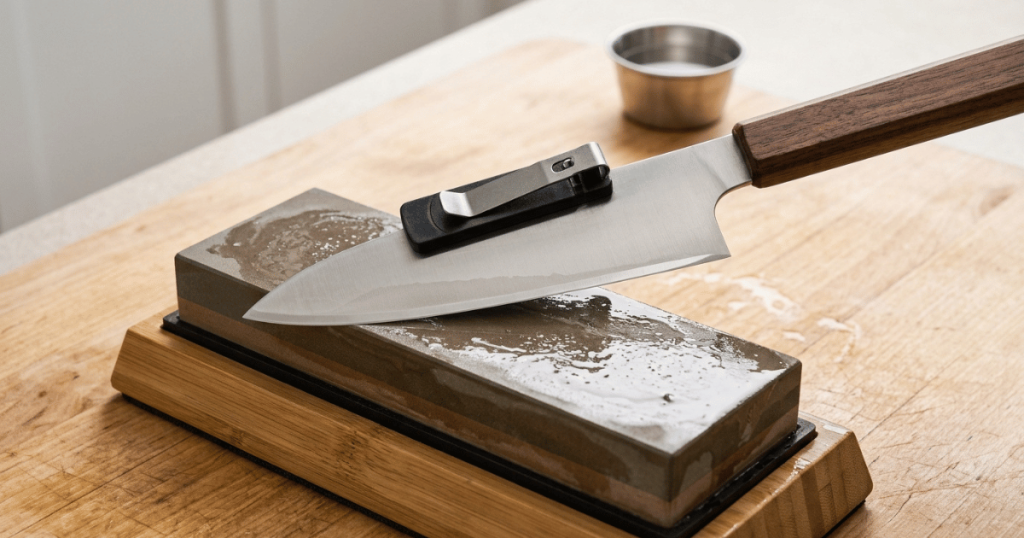
Color one bevel with a permanent marker. Set the knife on the stone at your best guess. Take three light passes. Look at what came off.
- Ink gone only at the very edge: your angle is too high, and you are riding on the apex.
- Ink gone only at the top of the bevel, away from the edge: your angle is too low, and you are grinding the shoulder.
- Ink gone evenly across the whole bevel: you have found the angle it was ground at. Stay there.
Do it on both sides. Many knives are ground evenly, some Japanese knives deliberately are not, and cheap knives are often visibly asymmetric straight from the factory.
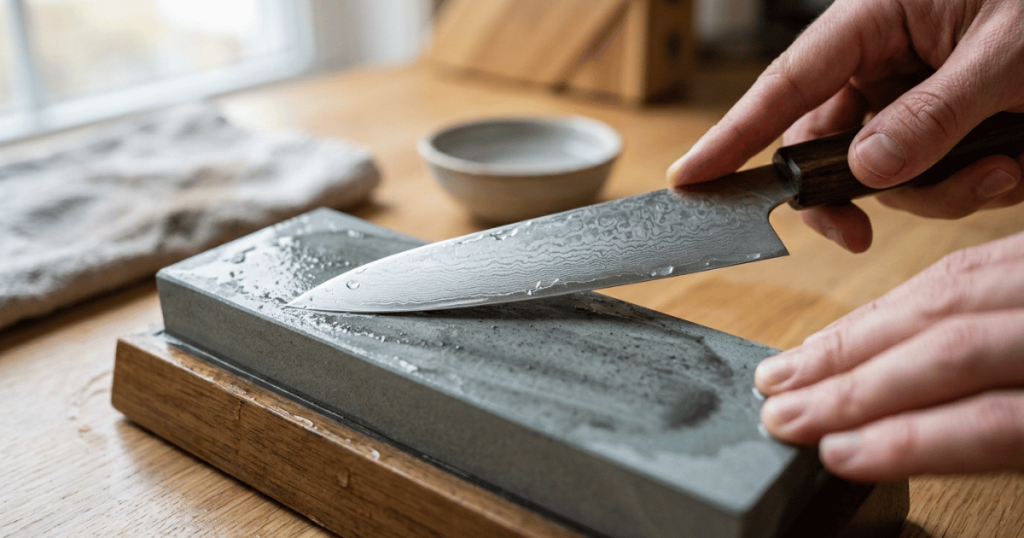
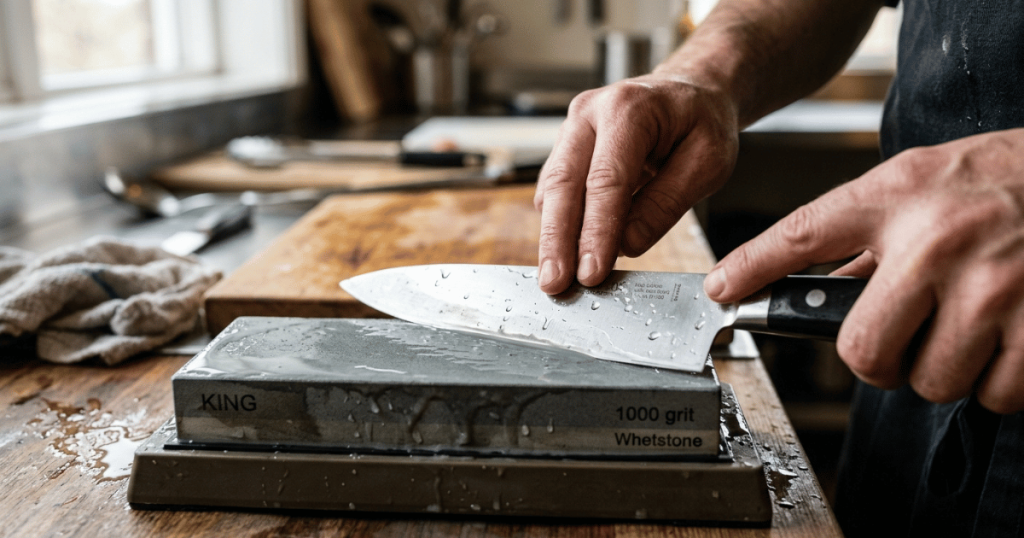
Before the knife comes out, set the stone down properly. It goes in its holder, or on a damp cloth on a non-slip mat, and you push it hard with the flat of your hand to check it will not travel. Three light passes is still three passes with a blade moving toward or away from a hand that is holding something wet. Keep your free hand’s fingertips flat on the spine side of the blade, above the edge, and never curled around the front of it. A stone that slides is the single most common way this ends badly, and it takes five seconds to prevent.
None of the four pages in the first table describes this test. That is the gap this article exists to fill, and it costs a marker.
If you use a guided system or a fixed-angle sharpener
The marker test still runs first, and it changes what you do next.
With a guide that has preset angles, set it to the preset closest to what the marker showed, not to a number a website gave you. A guide holding 15 degrees against a knife ground at 20 spends its first several minutes cutting an entirely new bevel before it reaches the apex, and until it gets there the knife gets duller, not sharper.
With a fixed-slot sharpener, the marker test tells you whether the machine’s angle matches your knife at all. Where it does not, you are re-profiling the edge every single time you use it, whether you meant to or not. That is worth knowing before you decide the knife is bad steel.
Does 15 versus 20 actually matter for a home cook?
Less than the argument suggests, and the trade-off is not controversial: a lower angle cuts with less effort and dulls sooner, a higher angle lasts longer and takes more push. Every source above states some version of it.
What they mostly leave out is the cost of switching. Knifewear gives the honest illustration: a chef who “sharpened his Victorinox like a Japanese knife” then “had to tune it up on a stone every day.” A softer Western steel taken down to a Japanese angle gets sharper and stops staying sharp. Run it the other way, a hard Japanese knife taken up to 20 degrees, and you get durability at the cost of the effortless slicing you paid for. Neither is wrong. Both should be chosen on purpose.
Work Sharp mentions in a single sentence that changing the angle “takes more time and material to accomplish than simply sharpening.” In practice that means grinding away everything behind the current apex until a new, lower bevel reaches the edge. On a thick German chef’s knife that is a long session on a coarse stone and a visible amount of metal. Stop halfway and you own a knife with two bevels and no clean apex, which feels worse than what you started with. If you are not prepared to finish it in one sitting, do not start it.
Should I change the angle when I sharpen?
Not by default. Match what the marker found and stop. Re-profile only when you can name the reason, and only when you can finish.
- It cuts the way you want and has simply gone dull. Find the bevel, sharpen at it, stop. This is almost everybody.
- The edge rolls or chips in ordinary use. The angle is probably too low for that steel or that board. Going up a few degrees helps, and it means grinding a new bevel.
- It feels wedgy and you want it to slice more freely. The angle, or the thickness behind the edge, is high. Going lower helps, at the cost of edge life, and it is a coarse-stone job.
- You have no idea what steel it is. The marker test still works. The angle it was ground at is the maker’s own judgment about that steel, which beats any table on the internet, including the one above.
One thing this changes about honing
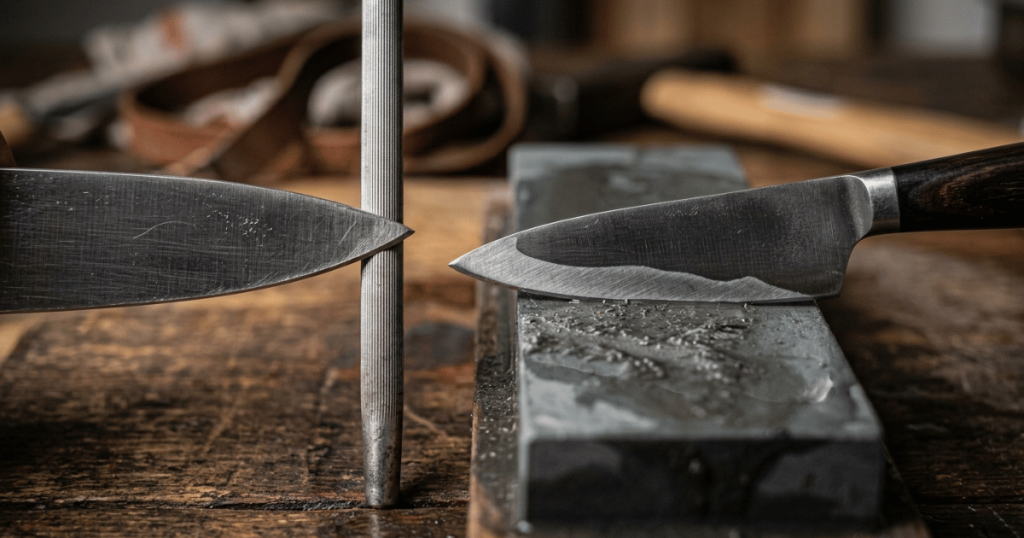
If you finish with a rod between sharpenings, hold the rod at the angle the marker found, not at a habit. A rod held steeper than the bevel does not realign the edge, it takes a little off the apex on every stroke. “Why is my knife duller after honing” very often has that as its answer. That is reasoning from how the tool works rather than a figure from a source, and it is offered as reasoning.
Frequently asked questions
Is 15 degrees per side or total?
Per side, in every source quoted on this page. A 15 degree edge is 30 degrees included. If a page does not say which convention it is using, you cannot safely use its number.
What angle does my knife come from the factory at?
Whatever its maker publishes, if it publishes anything. Wüsthof states 14 degrees for standard blades and 10 for its Asian-style ones, Shun states 16, Zwilling states 9 to 12 for Miyabi, Kramer and santoku and 10 to 20 for its standard range, Global states 10 to 15. Work Sharp’s own point stands on top of all of it: few individual knives are exactly at the published number, so the marker test beats the specification.
Is there one best angle for kitchen knives?
No. Four ranking pages give four answers and four makers publish figures from 9 to 20 degrees for their own products. The best angle for your knife is the one already on it, unless you have a specific reason to move it.
Can I just set my guided sharpener to 17 and be done?
You can, and on a knife already ground near 17 it will work well. On a knife ground at 20 or at 10 you are re-profiling it, which takes a full session and a lot of steel. Run the marker test and match the nearest preset instead.
Angles attributed to Sharpening Supplies, Knifewear, Work Sharp and Knife Aid are as those four pages were read in full on 17 August 2026. Maker figures from Wüsthof, Shun, Zwilling and Global are as quoted from those companies’ own care and FAQ pages on 24 August 2026. Where a source’s number is a product setting rather than a measurement, this page says so. Nothing here was measured by us, and no figure on this page is ours.