If your carbon steel blade has gone an even gray, blue-gray, brown or slate color, and the surface is smooth and nothing comes off on a cloth, that is patina and you should leave it there. It is a settled oxide layer that forms as the knife gets used, and America’s Test Kitchen describes it as a mild oxidation of the outer surface whose presence prevents further corrosion. Rust is the other one: orange or red-brown, powdery or flaky, it smears when you wipe it, and it keeps eating steel for as long as water and air reach it. Color is the first clue. Behavior is the test.
Getting this backwards is expensive in both directions. Scrub a good patina off and you have handed the knife back to bare steel. Ignore orange because someone told you carbon steel is supposed to change color and you lose metal.
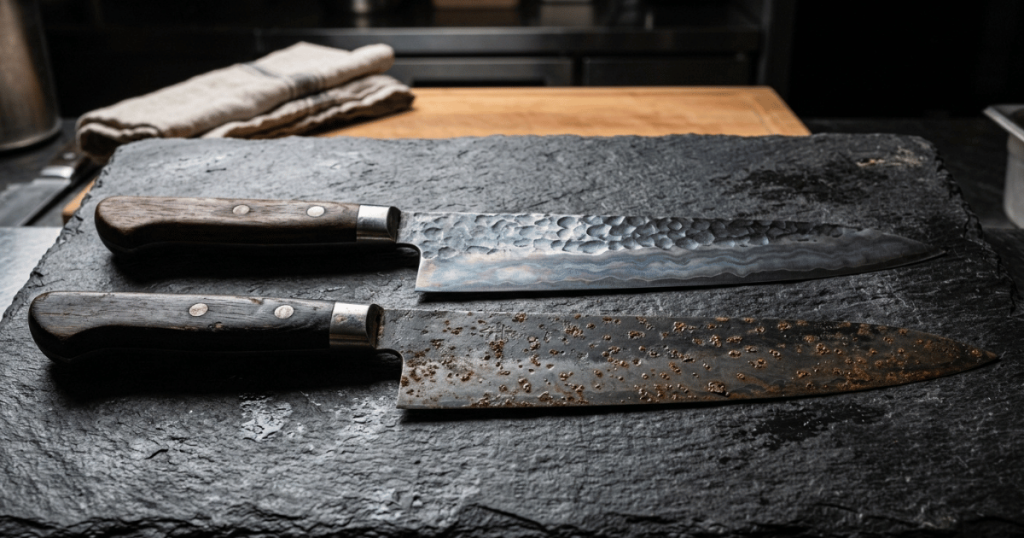
They are two different oxides, not two shades of the same stain
Carbon steel has little or none of the chromium that gives stainless its protection, so it reacts with its surroundings freely. What it produces depends on the conditions.
The dark layer is magnetite. America’s Test Kitchen calls it a mild form of oxidation that affects only the outer surface of the metal, turns carbon steel knives a charcoal gray, and forms when exposure to oxygen and water is limited, which is what happens when a knife is used, wiped and dried through a normal cooking session. It sits tight against the steel and it is stable.
The orange layer is the reactive form of iron oxide, and it behaves in the opposite way. It is porous rather than tight, it holds moisture against the metal instead of excluding it, and it lifts and flakes, which exposes fresh steel underneath for the process to start again. That is the whole difference and it is why one is a finish and the other is damage.
America’s Test Kitchen’s practical finding is the useful one for a home cook. In its work with carbon steel knives, a blade that had developed a light charcoal-gray patina naturally over time was less likely to rust if left wet than a bare one. The gray is not just tolerated. It is earning its place.
Read your own blade
| What it looks like | What it does when you wipe it | What it is |
|---|---|---|
| Even gray, slate or charcoal across the flats | Nothing comes off | Patina. Normal, wanted |
| Blue, purple or bronze tints, often in patches | Nothing comes off | Patina, colored by what you have been cutting. Normal |
| Brown or bronze, smooth, no texture | Nothing comes off | Patina. Normal, and it usually darkens with time |
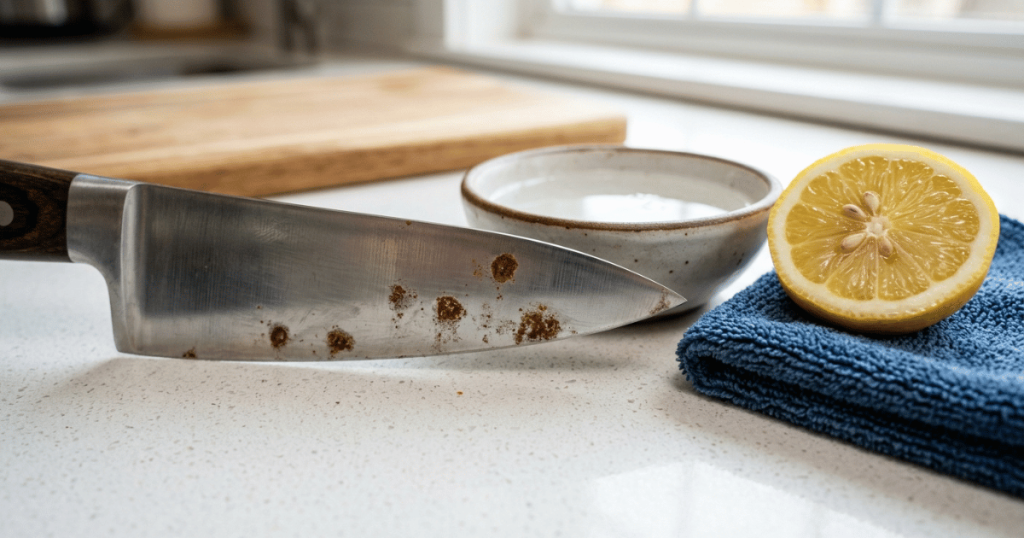
| Orange or red-brown, dull, slightly powdery | Smears, comes off on the cloth | Active rust. Remove it and find the water |
| Orange with a rough or flaky texture | Flakes lift, sometimes leaving a darker crater | Rust that has been there a while. Remove and inspect underneath |
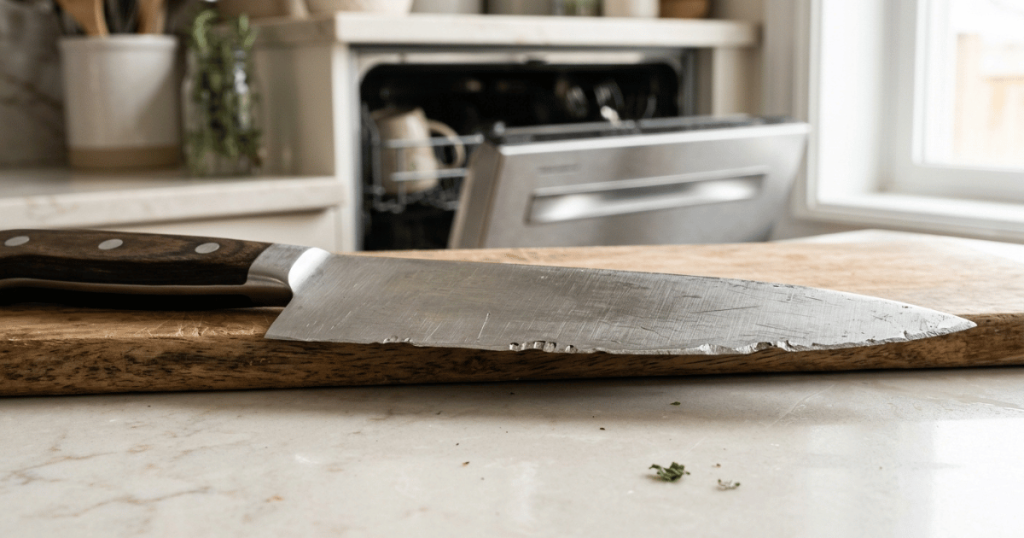
| Dark craters or pinpricks that stay after cleaning | Nothing to come off, you can feel them | Pitting. Steel is gone. Not patina |
| Blotchy gray patina with orange creeping at its edges | The orange smears, the gray does not | Both at once. Take off the orange only |
Two blades with the same patina rarely look identical, and that is expected. The color comes from what the knife has cut. Onions, tomatoes, citrus and vinegar are acidic and darken steel quickly, meat and fat less so, so a knife used mostly on vegetables patinates faster and blotchier than one used mostly on protein. Uneven color is not a fault. It evens out over months of use.
What a patina does, and four things it does not do
A settled patina slows corrosion on the surface it covers. That is the claim, and it is a modest one. Here is where people overextend it.
- It does not make a carbon knife stainless. Leave a patinated blade in a wet sink overnight and it will still rust. Less readily than bare steel, not immune.
- It does not cover the edge. The apex is freshly ground steel every time the knife is sharpened, and it is the thinnest, most exposed part of the blade. A patinated knife with a newly sharpened edge has a bare edge.
- It does not repair itself over a scratch. Steel wool, a scouring pad or a coarse stone strips it back to metal wherever it touches, and the layer has to grow again from there.
- It does not protect what it cannot reach. The joint where handle meets tang, under a bolster, inside a rivet hole: those are the places knives actually rust, and no amount of patina on the flats does anything about them.
How a patina forms without you doing anything
Use the knife, wipe it during the job, wash and dry it after. That is the entire method. The layer builds because the steel is repeatedly in brief contact with mild acids and moisture and then dried, which is the limited exposure America’s Test Kitchen describes as the condition magnetite forms under.
Expect it to look bad before it looks good. The first few weeks produce a blotchy, patchy blade with gray in some places and bright steel in others, and this is the stage where owners panic and polish it off, which resets the clock. A knife used most days settles into an even color over a few months.
Two things genuinely help along the way. Wipe the blade between ingredients rather than only at the end, which keeps acid contact brief instead of prolonged. And dry it immediately, every time, because the difference between forming patina and forming rust is largely how long the water stays.
Forcing a patina, and the cost nobody prints
Every forum thread on this topic ends up at the same trick: soak the blade in hot vinegar, or coat it in mustard or ketchup, and get in a few minutes the color that use takes months to produce. It works, in the sense that the blade turns dark.
America’s Test Kitchen tried the vinegar route and reported two problems with the result. The forced finish came out matte, which created undesirable drag in food, so the knife cut worse through dense ingredients than it had before. And the blade ended up rusting more easily than one that had patinated naturally. That is the sourced downside, from the one named test kitchen on the first page of results, and it is missing from nearly every how-to that teaches the method.
So we would not recommend forcing it on a knife you cook with. If you want the look and accept the trade, understand that you are choosing appearance now over both performance and protection. A patina you did not rush is a better one.
When the gray is hiding something
Patina is usually good news, but there are three cases where it is worth a second look.
Orange creeping in at the edges of a gray area. Both oxides can live on the same blade. Take the orange off with the gentlest thing that shifts it, working along the blade rather than across the edge, and leave the gray alone. Then work out what is leaving the knife wet, because rust that returns is a routine problem rather than a cleaning problem.
A rough or textured “patina”. A stable layer is smooth to the touch. If you can feel texture, or catch a fingernail on it, you are feeling pits, and those are permanent. Pitting on the flats of an old blade is a cosmetic history. Pitting on or through the cutting edge is a reason to have the knife assessed by a professional sharpener or retired, because a pitted apex cannot be sharpened clean without grinding the edge back behind the deepest damage.
Dark color at the handle seam. Discoloration concentrated exactly where the blade disappears into the handle is more likely to be moisture trapped in the joint than a normal patina, and what you can see is the small part of it.
Patina and the edge live on different schedules
Sharpening removes the patina from the bevel, every time, because sharpening removes steel. That is not a problem to solve. The bevel is bare after a stone session, it will darken again with a few days of use, and the darkening is not what makes the knife cut.
What it does mean is that a freshly sharpened carbon knife is at its most vulnerable at the exact place you least want a problem. Rinse and dry each knife when you finish it on the stone rather than leaving it wet while you work through the rest, and do not let a blade sit in stone slurry. Our guide to sharpening kitchen knives with a stone covers the working sequence, and the drying step belongs in it.
Japanese knives add a detail worth knowing. Many are clad, with a reactive core steel wrapped in a stainless jacket, so patina and rust both show up only where the core is exposed, which is the bevel and the edge. A blade like that can look pristine on the flats and be darkening or spotting along the edge at the same time. Our guide to sharpening Japanese kitchen knives explains where the core steel sits on those grinds, which is the strip to watch and to dry first.
Stainless steel does not do this
Stainless does not develop a useful patina, and if your stainless knife is discoloring, that is not the same phenomenon. Its corrosion resistance comes from a chromium-rich passive oxide film that forms naturally and regenerates when it meets oxygen, as the World Stainless Association describes it, and that film is invisible by design. What shows up on stainless instead is staining and pitting where the film has been broken down locally by salt or acid. Victorinox warns on its own care page that salty or acidic food left on a blade will stain it. Dark marks on stainless are a signal to change the routine, not a finish to encourage.
Frequently asked questions
Is patina on a knife the same as rust?
No. Patina is a dark, stable oxide layer, described by America’s Test Kitchen as a mild oxidation of the outer surface that prevents further corrosion. Rust is the orange, porous form that traps moisture, lifts and flakes, and keeps consuming steel. Patina stays put when you wipe it. Rust smears onto the cloth.
Should I remove the patina from my carbon steel knife?
No, unless you have a specific reason to strip the blade. Removing it returns the knife to bare steel with nothing between it and the next wet evening, and it takes months of use to build back. Remove orange rust, leave gray, blue and brown alone.
Why is my patina blotchy or blue?
Because the color comes from what the knife has been cutting. Acidic foods such as onions, tomatoes and citrus darken steel quickly and unevenly, so an early patina is usually patchy and can show blue, purple or bronze tints. It evens out over a few months of regular use.
Should I force a patina with vinegar or mustard?
We would not on a knife you cook with. America’s Test Kitchen found that a forced vinegar patina left a matte surface that created drag in food, and that the blade went on to rust more easily than one patinated naturally through use.
Does a patina mean I can stop drying my knife?
No. A patinated blade is less likely to rust when left wet than a bare one, which is not the same as being safe to leave wet. The routine does not change: wipe during the job, wash by hand, dry immediately, and pay attention to the joint where the handle meets the blade, which patina does not reach.