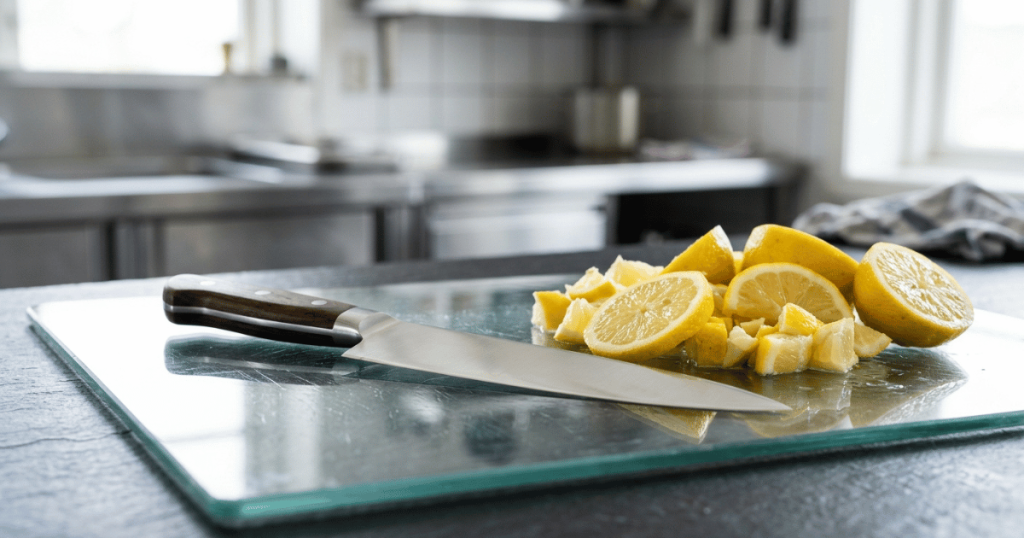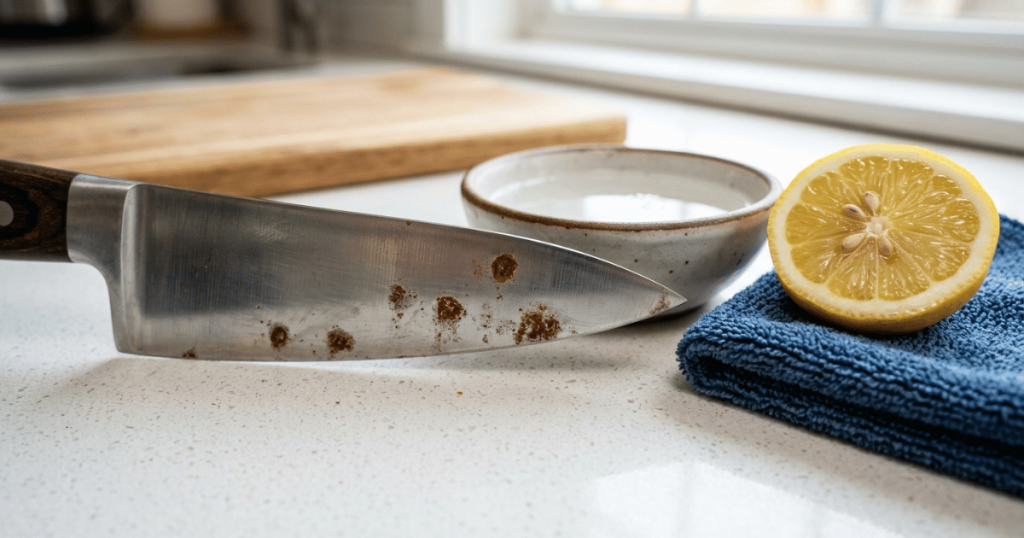
Rust needs water, oxygen and time on bare steel, and the only one of those you control is time. So the whole of prevention is this: rinse the blade the moment you finish with it, especially after salt, citrus, tomato, onion or vinegar, dry it with a towel right away instead of letting it drip, and never leave it in the sink or in a pile of wet dishes. On stainless that is usually enough. On carbon steel add a wipe during the job as well as after it, and a thin film of oil when the knife is going unused for a while. Everything else is detail.
If you have been doing all of that and a knife still rusts, you are almost certainly losing to a place water sits after the blade looks dry. That is the part of this most articles never get to.
Why the same routine is optional on one knife and mandatory on another
Two knives can sit in the same rack and only one of them blooms orange. The difference is not luck, it is what the steel has on its surface.
The World Stainless Association describes stainless steel’s corrosion resistance as coming from a chromium-rich passive oxide film that forms naturally on the surface and continuously regenerates when exposed to oxygen. That film is why a stainless knife forgives a night on the drainer. It is also why “stainless” is a description of behavior rather than a guarantee: the film can be broken down locally, and chloride-bearing conditions and acids are exactly what does it. Break it faster than it repairs and you get a stain, then a pit.
Carbon steel has little or none of that protection. Left bare and wet it goes straight to iron oxide, which is the orange kind, and the orange kind keeps going. What it does have is the other oxide: with regular use and drying, carbon steel develops a settled darker layer called patina, which America’s Test Kitchen describes as a mild surface oxidation that prevents further corrosion, and which its own kitchen work found made a blade less likely to rust when left wet. So carbon steel is not simply worse. It is a knife that builds its own protection if you let it, and rusts fast in the weeks before it has.
| Stainless | Carbon steel | |
|---|---|---|
| Built-in protection | A chromium-rich passive film that reforms in air | None at first; a patina it earns through use |
| Left wet for an hour | Usually fine, sometimes a water spot | Can start to bloom orange |
| Acidic food left on the blade | Discoloration, and pitting if it becomes a habit | Immediate darkening, and rust if left wet with it |
| Oiling | Not part of routine care for a knife in daily use | Worth doing before any idle period |
| Realistic goal | A clean blade | An evenly patinated blade with no orange on it |
The moisture traps, in the order they cost people knives
The blade is the easy part. Nobody rusts a knife they toweled dry. Water that stays behind after the towel is what does it, and it collects in a small number of predictable places.
The seam where the handle meets the blade. On a riveted, full-tang knife there is a joint between scale and tang, and on a bolstered knife there is a step where the blade runs into the bolster. Water wicks in there by capillary action, and no towel reaches it. It comes back out slowly, in contact with steel, in the dark. This is where a rust spot appears with no obvious cause and returns after every cleaning. The fix is not more cleaning: it is drying the knife with the handle end low so water runs out rather than in, and giving that seam a wipe of its own.
A blade put away warm and damp. A knife that feels dry after a hot wash is often still evaporating, and anything that traps that vapor around it keeps the blade in humid air for hours. Let a washed knife finish drying in open air on a towel before it goes anywhere enclosed.
Food residue you rinsed but did not wash. Salt and acid are the two things that attack the passive film on stainless, and a rinse in cold water leaves a film of both behind after a session with tomatoes, lemons or brine. Victorinox states plainly on its own care page that salty or acidic food can stain the blade if it is not cleaned off, and Wusthof adds that leaving knives sitting or soaking in the sink lets food residue such as spices, sauces and juices damage the blade and form corrosion spots.
The wet-dish pile. Two pieces of metal touching with water between them corrode faster than either does alone, and a blade under a wet cutting board or a stack of pans has neither air nor a way to drain. A knife should be the first thing washed and the first thing dried, on its own.
Water from sharpening. This one catches careful owners. A whetstone session leaves the blade soaked, covered in slurry and often set aside wet while the next knife is worked on, and a freshly sharpened edge is the most exposed steel on the knife because the apex has just been ground back to bare metal. Rinse and dry every knife when you finish the stone, not when you finish the batch. We cover the sequence in our guide to sharpening kitchen knives with a stone.
The routine, written as habits rather than rules
Prevention fails when it needs a separate step at the end of cooking. It works when it is part of the cooking.
- Wipe the blade during the job. A cloth kept beside the board and a wipe between ingredients removes the acids and juices while they are still wet. On carbon steel this single habit does more than anything else on this list.
- Wash the knife first, by hand, before anything else in the sink. Warm water and mild dish soap. Wusthof’s own instruction is to hand wash right after use and dry immediately with a soft cloth.
- Towel it, do not drip it. Victorinox advises against letting knives air dry, because evaporating water leaves limescale spots, and recommends a cotton or linen towel straight after washing. Dry the handle and that handle-to-blade seam as thoroughly as you dry the flat.
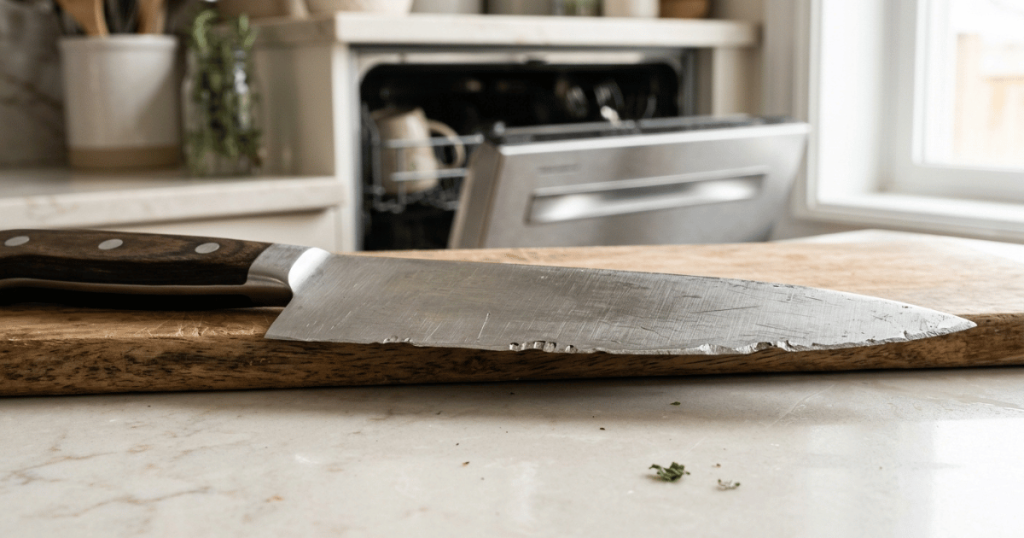
- Keep it out of the dishwasher. Heat, prolonged wet contact and alkaline detergent are a corrosion recipe, and Wusthof tells owners plainly not to place knives in a dishwasher.
- Put it away dry, whatever you keep it in. A dry blade does not care where it lives. A wet one rusts in every kind of storage there is.
Carbon steel: the first month decides the next decade
A new carbon steel knife is bare, reactive metal, and it is at its most vulnerable before it has built any patina. Treat the first weeks as the demanding part rather than assuming the knife is high maintenance forever.
Use it, and use it on ordinary food. The oxide layer forms through contact with air, moisture and the mild acids in what you cut, which is why a carbon knife that lives in a drawer stays raw and a carbon knife that gets used daily goes gray and calms down. Wipe it during the job, wash and dry it after, and let the color happen. If a blade develops an even gray, blue-gray or brown film, that is what you want. If it develops orange, you have left it wet somewhere and the answer is the routine above, not a stronger cleaner.
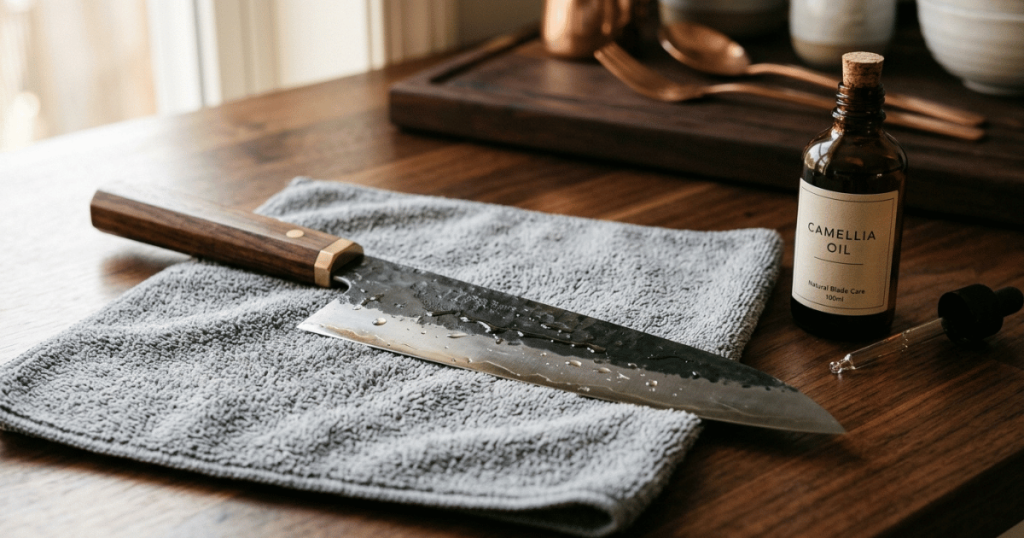
Where oil earns its place is the idle period. Korin, the Japanese knife specialist, describes tsubaki oil, the traditional camellia oil, as a natural oil used to prevent rust on carbon steel knives such as traditional Japanese blades, and its own advice is to apply it when knives are being stored for an extended period, for example while you are on vacation. That framing is the right one. Oil is a barrier for the time a knife is not being used and dried by hand, not a daily requirement for a knife you cook with every night.
Japanese knives add a wrinkle worth knowing about: many are clad, with a carbon or high-hardness core steel wrapped in a softer stainless jacket. On those, only the exposed core, the bevel and the edge, behaves like carbon steel, so rust shows up as a line along the edge while the flats look perfect. Our guide to sharpening Japanese kitchen knives explains where the core steel is exposed on those grinds, which is exactly the strip to dry first.
Prevention advice that backfires
Some of the most repeated tips make things worse, and it is worth saying which.
Oiling a knife that gets daily use. Oil on a blade you are about to wash again in six hours does very little except transfer to food and collect dust. It also hides the surface, so you stop seeing early staining. Save it for storage.
Oiling over rust. A film of oil on top of active corrosion seals the moisture underneath it in, not out. Take the rust off first, then dry, then oil if the knife is going away.
Scrubbing a carbon blade back to shiny. A polished carbon steel blade is bare steel again, with no patina and nothing between it and the next wet evening. Clean off orange, leave gray alone.
Assuming a stainless knife is exempt. The passive film is thin and it is chemistry, not armor. Salt and acid beat it locally, which is why stainless knives pit around the edge and the tip after months of casual treatment rather than rusting all over at once.
Wrapping a knife in a cloth or a sheath while damp. Anything absorbent held against steel holds water against steel. If it is going into anything close-fitting, it needs to be fully dry first.
If it keeps happening, find the cause rather than the cure
A knife that rusts once had a bad night. A knife that rusts repeatedly in the same spot is telling you where the water is. Look at where the marks appear: at the seam means the handle joint, along the edge only means it is a clad blade with exposed core steel, on one flat only means it is sitting against something wet, and all over means it is being put away before it is dry.
There is also a limit worth naming. If the marks are dark pits that stay after cleaning rather than orange bloom that comes off, prevention is no longer the question, because pitting is steel that has already gone. Pitting on the flat of an old blade is cosmetic. Pitting on or through the cutting edge means the knife needs a professional assessment or retirement, because a pitted apex cannot be honed or sharpened clean without grinding the edge back behind the damage. How much metal that costs, and whether it is worth doing, is covered in our guide to sharpening kitchen knives.
Frequently asked questions
How do I keep my kitchen knives from rusting?
Rinse the blade as soon as you finish with it, wash it by hand with warm water and mild soap before anything else goes in the sink, and towel it dry immediately including the handle and the seam where the handle meets the blade. Keep it out of the dishwasher and never let it soak. On carbon steel, add a wipe during the job and a thin film of oil before any period of not using it.
Do stainless steel knives rust?
They stain and pit rather than rusting all over, and yes, it happens. Stainless resists corrosion because of a chromium-rich oxide film on its surface that reforms in air, but salt, acid and standing water break that film down in one spot faster than it repairs. Victorinox warns on its own care page that salty or acidic food left on the blade will stain it.
Do I need to oil my kitchen knives?
Not as routine care for a stainless knife in regular use. For carbon steel it is worth it before any stretch where the knife will sit unused, which is how Korin frames camellia oil on its own product page: apply it when you are storing knives for an extended period. Use an oil whose own label states it is intended for use on food-contact items, and take rust off before oiling rather than sealing it under.
Why does my knife rust in the same spot every time?
Because water is sitting there after the rest of the blade has dried. The usual suspects are the joint between handle and blade, the step at a bolster, and one flat resting against something damp. On a clad Japanese knife, rust along the edge alone is the exposed core steel, which is not stainless even though the flats are.
Is a rusty knife dangerous to cook with?
Light surface rust is a knife-care problem rather than a food problem, and it should still come off before the blade goes back to work. The real concern is structural: pitting on or near the cutting edge weakens a thin section of steel and leaves an apex you cannot sharpen clean, and a knife in that state should be assessed by a professional sharpener or retired.