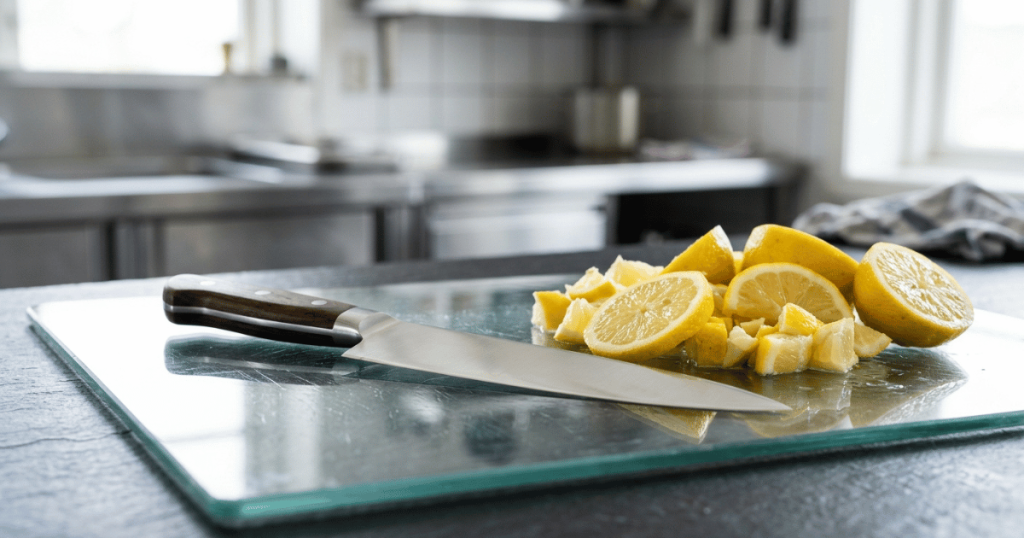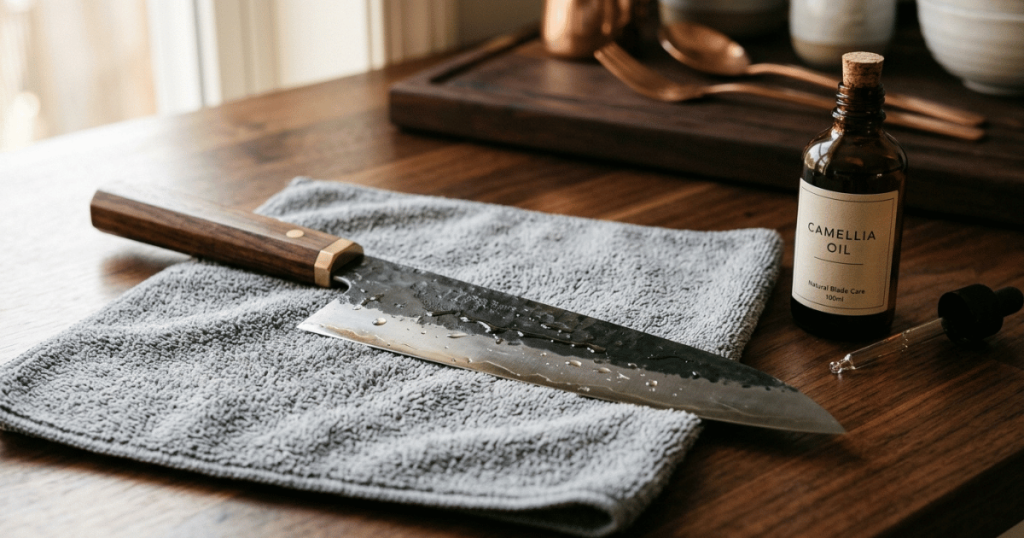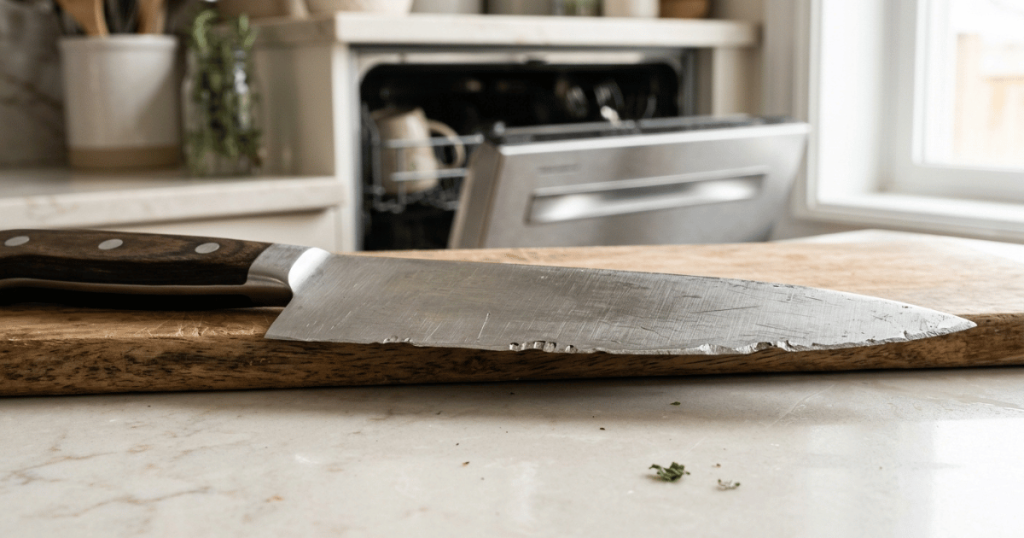
Wash and dry the knife, lay it flat on a folded towel with the edge pointing away from your working hand, and take the orange off with the mildest abrasive that shifts it, working along the blade rather than across the edge. A baking soda paste first, a mild acid such as lemon juice or diluted vinegar applied to the spot and rinsed off next, an oxalic acid cleanser or a rubber rust eraser last. Stop as soon as the orange color is gone. Dark pits left behind are steel that has already been eaten away, and no amount of scrubbing brings it back.
The part almost nobody writes down is the part that decides the outcome: what the mark on your blade actually is, and when to put the abrasive down.
Work out what you are looking at before you touch it
Three different things show up on kitchen blades and only one of them is rust you should remove. Getting this wrong is how people scrub away a protective layer, or spend an hour polishing damage that was never going to come out.
| What you see | What it is | What to do |
|---|---|---|
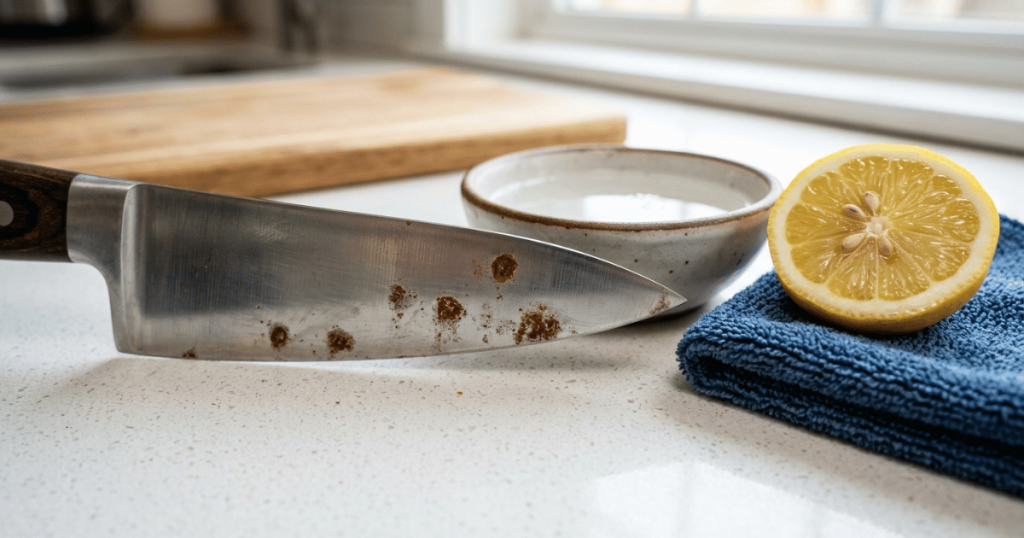
| Orange or red-brown bloom, powdery or flaky, wipes and smears | Active surface rust, iron oxide sitting on top of the steel | Remove it, then find out what left the knife wet |
| Even gray, blue-gray or brown film on a carbon steel blade that does not wipe off | Patina, a settled oxide layer | Leave it alone. It is doing a job |
| Small dark craters that remain after the orange is cleaned off | Pitting, corrosion that has gone into the steel | Clean the surface, then assess. It does not come out |
| Cloudy white or chalky marks | Mineral deposits from water evaporating on the blade | Not rust. A damp cloth and a dry towel |
The reason the distinction matters is chemistry rather than appearance. On carbon steel, a stable gray patina is a mild surface oxidation that America’s Test Kitchen describes as preventing further corrosion, and its own testing found that a blade with a naturally developed charcoal-gray patina was less likely to rust when left wet. Orange bloom is the reactive form, and it keeps consuming steel as long as water and oxygen reach it. Scrub the first one off and you have removed a layer that was protecting the knife. Leave the second one on and it spreads.
Stainless steel is not exempt from any of this. The World Stainless Association describes its corrosion resistance as coming from a chromium-rich passive oxide film that forms naturally on the surface and regenerates when exposed to oxygen. Resistance is not immunity. Where that film is broken down locally, which chloride-bearing conditions and acids do, stainless pits and stains like anything else. Victorinox says the same thing in kitchen terms on its own care page, warning that salty or acidic food left on a blade will stain it.
Set the knife up before any abrasive touches it
This is the step the method posts skip, and it is the one that involves a hand, an edge and pressure in the same place.
Put a folded kitchen towel on a stable counter and lay the knife flat on it, edge pointing away from the hand doing the work. The towel stops the blade sliding and gives the spine something to sit against. Hold the knife by the handle, not by the blade, and keep your other hand behind the edge line at all times. Never hold a knife in the air while you scrub it, and never work with the blade balanced over a sink where a slip has nowhere to land.
Work the cloth, pad or eraser along the length of the blade, spine to tip, in the same direction as the blade runs. Do not work across the blade toward the edge, because that is the stroke that puts your fingers over the sharp side under pressure. Rust near the edge itself gets the lightest touch of anything on the knife: approach it from the spine side, keep the pressure low, and accept leaving a trace of discoloration rather than pushing a loaded cloth over an apex.
If the knife has a wooden handle, keep the water and the cleaner off the wood and out of the joint where the handle meets the tang. If a knife is already loose or rattling in its handle, do not work on it at all until that is fixed. Force applied through a moving handle is how the blade ends up somewhere you did not intend.
Two things do not belong in this job. Bench grinders, wire wheels and rotary tools are not for kitchen knives: a wheel can catch a thin blade and throw it, and heat generated at the edge can affect the temper the maker put there. Steel wool and coarse grits leave scratch patterns that trap moisture and start the next round of corrosion. Reach for those only if you have already decided the knife is a project rather than a kitchen tool.
The removal ladder, gentlest first
Treat these as a ladder, not a menu. Start at the top, stop the moment the orange is gone, and do not stack methods on the same spot in one session.
- Dish soap, warm water and a nylon pad. Very fresh bloom often comes off here, and this costs the blade nothing.
- Baking soda paste. Mix baking soda with a little water into a thick paste, spread it on the rusted area, give it a few minutes, then rub along the blade with a cloth or a soft brush. This is the mildest abrasive in most kitchens.
- A mild acid, applied rather than soaked. Lemon juice or vinegar diluted with water, put on the spot with a cloth or a cotton pad and rinsed off. Every page on the first results page tells you to soak the blade for hours. We would not: a long acid bath is indiscriminate, it works on the healthy steel and the finish as much as the rust, and on a wooden-handled or riveted knife it puts acid into exactly the joint you cannot dry out. Spot treatment does the same chemistry where you want it.
- An oxalic acid cleanser or a rubber rust eraser. This is the strongest step that belongs in a kitchen. It is also the one with a label, and the label is worth reading.
Read the cleanser’s own directions, because they are stricter than the blog posts
Bar Keepers Friend, the oxalic acid cleanser most of these articles reach for, publishes directions on its own product page that are noticeably more cautious than the way it usually gets recommended: sprinkle onto a wet surface, rub gently with a wet cloth or sponge, rinse thoroughly within a minute of application, then wipe dry. The same page adds that to avoid damage you should not let the product sit longer or rub harder than necessary, and to test a small hidden area first. It also tells users to keep it out of the eyes and off skin during prolonged use, and never to mix it with bleach or ammonia.
That one-minute rinse window is the maker’s own number, and it is not a detail. Left to dry on a blade, an acid cleanser stops being a rust remover and becomes something etching your finish. Whatever product you use, the instruction on the bottle outranks the instruction in any article, including this one.
When the rust is off, the knife is not finished. Wash it with dish soap and warm water and rinse it properly, because it has just had cleaning product on a surface that touches food, then dry it immediately with a towel. Wusthof’s care page makes the drying point plainly and adds the other half of it: do not leave knives sitting or soaking in the sink, because food residue can damage blades and cause corrosion.
The stop condition
Stop when the orange is gone. That is the whole test.
What is left underneath is the actual state of the steel. If the surface is smooth and evenly colored, you are done. If you can see dark pinpricks or craters that stay after cleaning, that is pitting, and continuing to work on it only removes healthy metal around the damage. Nothing you can do at a sink puts steel back. Polishing a pit until it disappears means grinding the entire blade surface down to the bottom of the pit, which is a workshop job on a knife worth that effort, not a Tuesday evening one.
Stop immediately and reassess if the knife heats up under your hand, if the finish starts to change color or haze, or if the rust is coming from underneath the bolster or from the seam between handle and tang. Corrosion appearing at that seam usually means water has got inside the handle, and the visible spot is the small part of it.
When a rusted knife should be retired instead of restored
No retailer’s care page will tell you this, so here it is. Rust is a cosmetic problem right up until it reaches the edge, and then it is a structural one.
Take the knife out of service, or hand it to a professional sharpener or the maker’s repair service, when any of the following is true:
- Pitting is on or through the cutting edge. An edge is a thin apex, and a pit there means the apex has holes in it. The knife cannot be honed clean and it cannot be sharpened clean without grinding the whole edge back behind the deepest pit, which costs real blade height.
- Pitting is deep enough to catch a fingernail anywhere near the edge or near the tip. Deep pits concentrate stress in a thin section.
- Rust is at the tang, the rivets or under the handle. You cannot see how far it has gone and you cannot dry what you cannot reach.
- The blade flexes, rattles or shows a crack line. That is not a cleaning question at all.
An old carbon steel knife with light pitting up on the flat, well away from the edge, is a perfectly good knife with a history. The same knife with pitting along the bevel is finished as a kitchen knife, and asking more of it is asking a compromised edge to take force in your hand.
After the rust: check the edge, not just the shine
Rust removal and sharpening meet at the same few millimeters of steel. Once the blade is clean and dry, test the edge before you decide the job is done. Our guide on telling whether a knife is actually sharp covers the checks that do not involve running a thumb along an edge you just worked on.
If corrosion reached the apex and the edge now feels rough or fails those checks, the fix is sharpening, not more cleaning, and it needs enough metal removed to get behind the damage. That is a job for a stone rather than a quick pass on a pull-through, and the sequence is laid out in our guide to sharpening kitchen knives. Choosing where to start in the grit sequence matters more than usual here, because a coarse stone will fix pitted edge damage fast and take blade height with it. Our whetstone grit guide explains what each grit range actually does so you can start no coarser than the damage requires.
What not to do
Do not soak a knife overnight in anything, acid or otherwise. Do not put a rusty knife through the dishwasher hoping it will help. Do not use a knife’s rust as an excuse to sand the whole blade with coarse paper, since a scratched surface holds water better than a smooth one. Do not oil over rust: oil on top of active corrosion seals the moisture in rather than out. And do not scrub the gray off a carbon steel blade that has spent years earning it.
Frequently asked questions
How do I get rust off kitchen knives without damaging them?
Start with the mildest thing that works and stop as soon as the orange is gone. Dish soap and a nylon pad, then a baking soda paste, then lemon juice or diluted vinegar applied to the spot and rinsed off, then an oxalic acid cleanser or a rubber rust eraser as the last step. Work along the blade with it flat on a towel, edge pointing away, and wash and dry the knife afterward.
Should I soak a rusty knife in vinegar?
We would not. A long soak attacks the good steel and the finish along with the rust, and on a knife with a wooden handle or rivets it drives acid into a joint you cannot dry. Applying the acid to the rusted spot with a cloth and rinsing it off gets the same reaction where you want it.
Is the gray film on my carbon steel knife rust?
No. An even gray, blue-gray or brown layer that will not wipe off is patina, a mild surface oxidation that America’s Test Kitchen describes as preventing further corrosion. Orange or red-brown bloom that smears and flakes is rust. The first one stays, the second one goes.
Can pitting be removed from a knife blade?
Not without removing the steel around it. A pit is a hole where metal used to be, so the only way to make it disappear is to grind the whole surface down to the bottom of the pit. On the flat of an old blade, pitting is cosmetic and worth living with. On or near the cutting edge it is a reason to retire the knife or have a professional assess it.
Why do my stainless knives rust at all?
Because stainless resists corrosion rather than preventing it. Its protection comes from a thin chromium-rich oxide film on the surface, and salt, acid and standing water can break that film down in one spot faster than it repairs. Victorinox warns on its own care page that salty or acidic food left on a blade will stain it, which is the same process at an earlier stage.